Insights & Resources
Apparel Manufacturing Blog
Industry news, production guides, and trend analysis from Los Angeles clothing experts.
Choosing a Custom Bomber Jacket Manufacturer requires more than comparing sample prices. A reliable partner must balance fabric performance, construction quality, production capacity, and delivery control. Your jacket may look simple, yet its ribbed cuffs, metal zipper, lining, pocket reinforcement, and embroidery each reveal manufacturing discipline.
The Textile Exchange Materials Market Report 2024 states that global fiber production reached approximately 124 million tonnes in 2023, with polyester representing about 57% of total output. This matters when selecting shell fabrics, recycled options, and supplier documentation. McKinsey’s The State of Fashion 2024 also highlights continuing pressure from cautious consumers, volatile costs, and disrupted supply chains. Fashion expert Achim Berg described the situation as “a perfect storm” for the industry. His warning applies directly to custom production: a low quotation may hide delays, weak quality control, or expensive rework.
Ask for measurable evidence. Request fabric composition, GSM, colorfastness results, zipper specifications, and pre-production samples. Inspect stitching density around the armholes and pockets. Check whether the factory can repeat the same measurements across multiple sizes. A good manufacturer should explain minimum order quantities, sample charges, inspection procedures, and replacement policies clearly.
No factory is perfect. A spreadsheet can still mislead. The most dependable choice combines documented capability with honest communication. Before signing, test one complete sample through washing, abrasion, and repeated zipper use. This extra step may feel slow, but it exposes problems while they remain affordable. The right Custom Bomber Jacket Manufacturer is not simply the cheapest supplier; it is the partner that can consistently turn a technical specification into a wearable, saleable product.
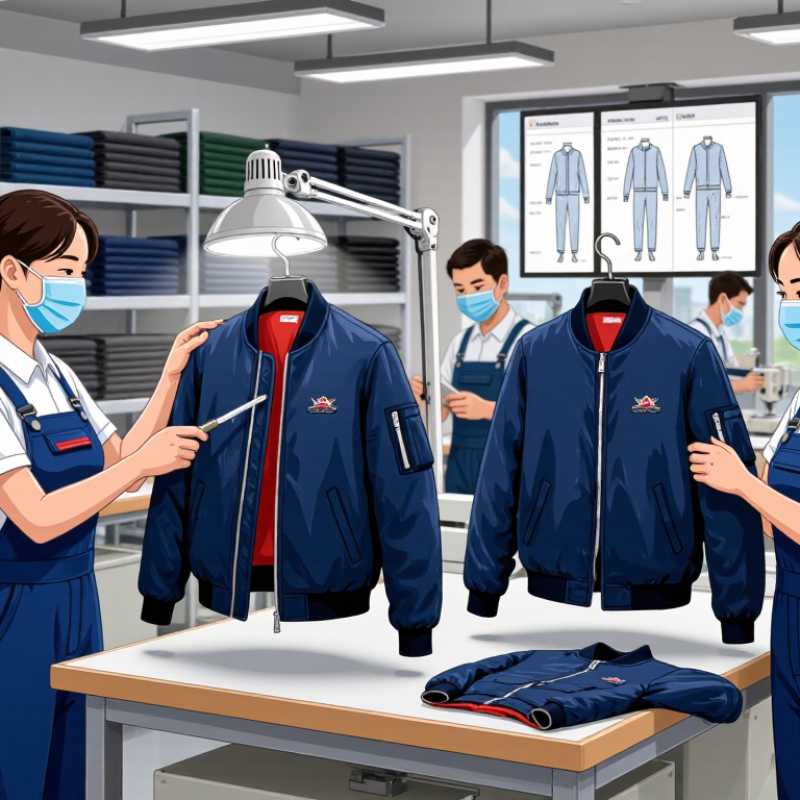
Define Your Custom Bomber Jacket Requirements
Before choosing a custom bomber jacket manufacturer, define the product clearly. A factory cannot quote accurately from a vague idea. Record the jacket’s purpose, target wearer, season, quantity, and expected price range. A lightweight nylon bomber needs different construction from a heavy wool version. Consider the climate, too. Warm linings may feel uncomfortable in mild weather.
Create a practical specification sheet with shell fabric, lining, rib-knit composition, zipper type, pocket positions, and closure details. Add measurements for the chest, sleeve, body length, and cuff width. Include your size range and measurement tolerances. A simple sketch helps, but a detailed tech pack reduces costly misunderstandings. Add color references and fabric swatches whenever possible. Screenshots alone can mislead.
Think about wear and production testing. Ask for a sample before approving bulk manufacturing. Check seam strength, zipper movement, pocket depth, rib recovery, and color consistency under normal light. I have seen attractive samples fail because the sleeves twisted after washing. That detail matters. Fabric substitutions can also change the jacket’s weight and shape, so require written approval before changes. Your requirements may evolve during sampling, and that is normal. However, unclear revisions often create delays, uneven sizing, or unexpected costs. A reliable manufacturer should explain which details are realistic, which need adjustment, and how each change affects production.
How to Choose a Custom Bomber Jacket Manufacturer? - Define Your Custom Bomber Jacket Requirements
| Requirement Dimension | Recommended Specification to Define | Common Custom Options | Information to Request from the Manufacturer | Priority |
|---|---|---|---|---|
| Jacket Type | State the intended style and use before requesting a quotation. | Classic MA-1, varsity bomber, oversized fashion bomber, reversible bomber, lightweight bomber, or insulated bomber. | Confirm whether the factory has made the selected construction and can provide relevant samples. | High |
| Target Market and Season | Define the customer location, climate, selling season, and expected retail positioning. | Spring/autumn lightweight use, winter insulation, urban streetwear, workwear, or premium fashion. | Ask about fabric suitability, insulation performance, testing capabilities, and seasonal production capacity. | High |
| Outer Fabric | Specify fiber content, fabric weight, finish, hand feel, and performance needs. | Nylon, recycled nylon, polyester, cotton twill, wool blend, satin, ripstop, water-repellent, or matte finish. | Request fabric composition, weight in g/m², colorfastness results, shrinkage data, and available test reports. | High |
| Lining and Insulation | Define lining composition and warmth level according to the target climate. | Polyester lining, quilted lining, mesh lining, recycled polyester fill, synthetic padding, or no insulation. | Confirm fill type, fill weight, quilting method, lining color, and washing performance. | High |
| Color and Color Matching | Provide physical swatches or recognized color references for each material and trim. | Solid colors, contrast sleeves, garment dye, piece dye, custom rib colors, and seasonal palettes. | Ask for lab-dip approval procedures, color tolerance standards, and production approval samples. | High |
| Fit and Size Range | Prepare a measurement chart with tolerances, grading rules, and the preferred fit. | Regular fit, relaxed fit, cropped fit, oversized fit, unisex sizing, or extended sizes. | Request a size-set sample, measurement tolerances, pattern approval process, and grading experience. | High |
| Closure and Hardware | Specify the front closure, hardware finish, puller design, and durability expectations. | Metal zipper, molded zipper, snap buttons, matte hardware, polished hardware, branded pullers, or custom engraving. | Ask for hardware material, finish options, corrosion testing, zipper testing, and replacement-part availability. | Medium |
| Rib and Cuff Construction | Define rib composition, stretch, recovery, width, and color matching. | Polyester rib, cotton-blend rib, wool-blend rib, striped rib, contrast rib, or custom jacquard rib. | Request rib test results, recovery performance, dimensional stability, and available knit structures. | Medium |
| Decoration and Branding | Identify artwork placement, artwork dimensions, decoration method, and label requirements. | Embroidery, chenille, screen printing, heat transfer, woven patch, silicone patch, woven label, or hangtag. | Confirm artwork format, stitch or print limitations, sampling charges, placement tolerances, and approval steps. | High |
| Functional Details | List every pocket, lining feature, seam detail, reinforcement, and internal component. | Zipped pockets, welt pockets, sleeve pocket, inside pocket, storm flap, reflective tape, and reinforced seams. | Ask for a technical pack review, construction drawings, seam specifications, and sample inspection points. | High |
| Minimum Order Quantity | Set the total order quantity and the quantity per color and size before supplier selection. | Small-batch development, standard production runs, or larger volume programs. | Request MOQ by style, color, and fabric; also confirm whether mixed sizes and colors are accepted. | High |
| Sample Development | Define the required sample stages and the approval deadline. | Proto sample, fit sample, sales sample, size set, pre-production sample, and shipment sample. | Ask for sample lead time, sample fees, revision limits, courier arrangements, and approval documentation. | High |
| Quality Standards | Document acceptable measurements, workmanship standards, defect limits, and inspection procedures. | Inline inspection, final inspection, measurement audit, needle detection, and third-party inspection. | Request quality-control procedures, inspection records, corrective-action policy, and product test reports. | High |
| Compliance and Sustainability | Identify the destination-market requirements and any restricted-substance or recycled-content claims. | Fiber-content documentation, restricted-substance testing, recycled-material documentation, and social-compliance audits. | Ask for current certificates, test reports, traceability documents, and the scope and validity dates of audits. | High |
| Packaging and Labeling | Specify folding method, packaging material, carton markings, labels, and barcode requirements. | Individual polybag, recycled packaging, tissue paper, size stickers, care labels, carton labels, and barcodes. | Confirm packaging dimensions, carton quantity, labeling format, packaging cost, and compliance requirements. | Medium |
| Cost and Payment Terms | Set the target cost, currency, quotation validity, tooling costs, sample charges, and payment schedule. | Per-piece pricing, tiered pricing by volume, separate decoration charges, sampling fees, and mold or plate fees. | Request a detailed quotation showing fabric, trims, labor, decoration, packaging, testing, and shipping costs separately. | High |
| Production and Delivery Schedule | Define the required in-store date, approval milestones, production window, and shipping method. | Air freight, ocean freight, rail freight, courier shipment, split delivery, or consolidated shipment. | Ask for realistic sample and bulk lead times, production capacity, holiday closures, and shipment tracking procedures. | High |
Note: Lead times, minimum order quantities, costs, and testing requirements vary by construction, material, order volume, destination market, and production season. Confirm all specifications in writing before placing an order.
FAQS
Define the jacket’s purpose, wearer, season, quantity, and target price. A lightweight jacket needs different construction from a heavy wool version. Include climate details. Warm linings can feel uncomfortable in mild weather.
List the shell fabric, lining, rib composition, zipper type, pockets, and closure details. Add chest, sleeve, body-length, and cuff measurements. Include size ranges and measurement tolerances. A simple sketch helps.
Screenshots can display colors inaccurately on different screens. Send physical swatches whenever possible. Confirm fabric weight and fiber content. Small changes can alter the jacket’s shape.
Test zipper movement, seam strength, pocket depth, rib recovery, and lining attachment. Check sleeve alignment after washing. Look for twisted sleeves. That failure matters.
Require written approval before any material changes. A substituted fabric may change weight, color, warmth, or fit. Review the revised sample before bulk production. My first choice may not remain practical.
Request quotes for several quantities, such as 50, 100, and 300 pieces. Confirm whether pricing includes labels, packaging, patterns, revisions, and shipping. A low minimum order can raise the unit price sharply. That trade-off may still suit a first run.
Sampling may take 7–14 days. Production may require 30–60 days. Fabric sourcing and custom rib knitting can add more time. These are planning benchmarks, not promises.
Record approval deadlines, inspection steps, remake rules, and payment milestones. Confirm the final measurements and approved materials. Ask how delays will be handled. Perfect estimates deserve questions.
Conclusion
Choosing the right Custom Bomber Jacket Manufacturer starts with clearly defining your product requirements, including design, fit, fabric, colors, features, branding, and intended order volume. A suitable manufacturer should have proven experience producing bomber jackets and the equipment, skilled workforce, and production capacity needed to meet your specifications consistently. Review their material selections, customization options, quality control procedures, and ability to maintain accurate sizing and finishing standards.
Before making a decision, request samples to assess construction, comfort, stitching, and overall quality. Compare pricing carefully while considering minimum order quantities, sampling fees, payment terms, and estimated lead times. Reliable communication is equally important, so evaluate how promptly and clearly the manufacturer responds to questions and handles revisions. Finally, verify production compliance, ethical working practices, quality documentation, and after-sales support. A manufacturer that demonstrates transparency, flexibility, and dependable delivery is more likely to become a stable long-term production partner.