
Insights & Resources
Apparel Manufacturing Blog
Industry news, production guides, and trend analysis from Los Angeles clothing experts.
How to Find Men Cargo Shorts Set OEM Suppliers
Table of Contents
- Define the Product Specifications for a Men’s Cargo Shorts Set
- Identify OEM Supplier Channels and Manufacturing Locations
- Assess Supplier Capabilities, Compliance, and Minimum Order Quantities
- Request Samples to Verify Fabric, Fit, and Construction
- Compare Quotations and Confirm Production Terms
- FAQS
- Conclusion
- Related Posts
Finding a reliable Men Cargo Shorts Set OEM supplier takes more than comparing unit prices. Buyers need to assess fabric quality, pocket construction, sizing consistency, production capacity, and communication. Small details matter: a zipper that catches, a bar tack that loosens, or a waistband that twists can undermine an otherwise strong sample. The challenge is real.
Textile Exchange’s Materials Market Report 2024 estimates that global fiber production reached 124 million tonnes in 2023 and could rise to 160 million tonnes by 2030. This figure covers fibers across many uses, not cargo shorts alone. Still, it highlights why material specifications and traceability deserve attention during supplier screening. Ask factories to identify fabric composition, weight, finishing, and available test documentation. Then check whether their sample matches the written specifications.
A practical sourcing review should also compare minimum order quantities, sample timelines, lead times, defect handling, and quality-control procedures. Request close-up photos of seams, pocket openings, and stress points, but treat photos as supporting evidence, not proof. A factory may present a polished sample and still struggle with bulk consistency. That assumption is worth challenging. Confirm production details in writing, review a pre-production sample, and clarify how changes are approved before manufacturing begins. These steps cannot guarantee a smooth order, but they make supplier claims easier to verify.
Define the Product Specifications for a Men’s Cargo Shorts Set
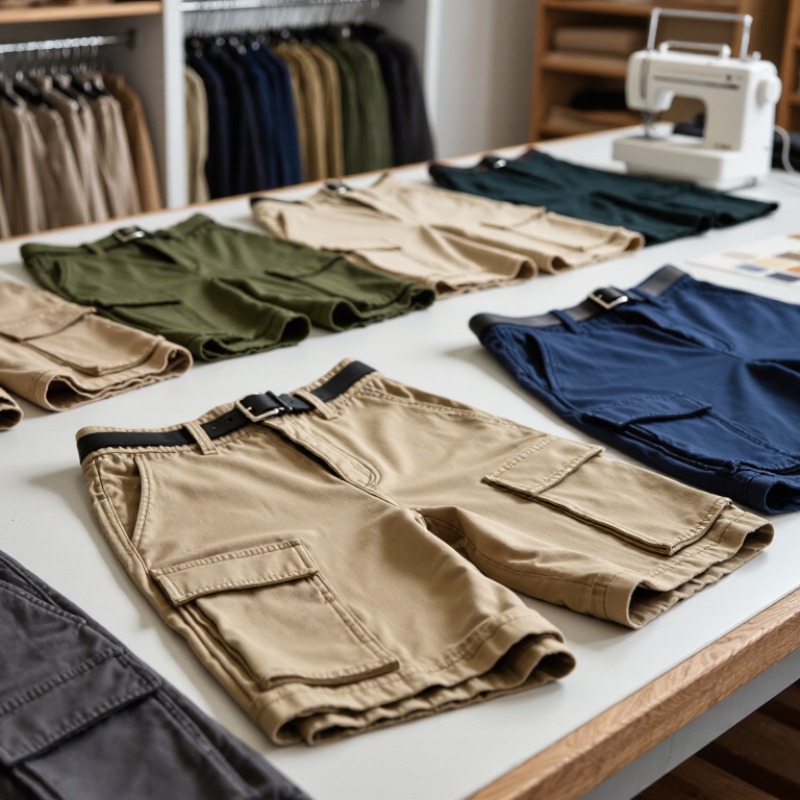
Before contacting an OEM supplier, define exactly what the men’s cargo shorts set includes: shorts alone, or shorts paired with a matching shirt. Specify the fabric composition, weight in grams per square metre, weave, stretch, and finish.
Textile Exchange’s 2024 Materials Market Report estimates global fibre production reached 124 million tonnes in 2023, with polyester making up about 57%. That scale makes fibre choice worth documenting, not guessing.
Record whether you want cotton, polyester, a blend, or recycled content, and request supporting material details. Keep the first brief practical.
For the shorts, provide a measurement chart for waist, hip, rise, inseam, leg opening, and pocket dimensions. State the size range and acceptable measurement tolerances. Describe pocket placement and construction, including flap shape, closure, stitching, and reinforcement.
Small details matter. A phone should fit without pulling the pocket opening out of shape.
For the matching piece, specify its fit, neckline or collar, sleeve length, and how its colour should match the shorts. Ask for sample measurements, shrinkage and colourfastness test results, and a pre-production sample before approving bulk production.
I would not assume a standard size chart will suit every market; that assumption can create costly revisions. Keep a dated specification sheet so both sides can check changes against the same details.
Identify OEM Supplier Channels and Manufacturing Locations
OEM supplier channels should be checked against the kind of factory you need. Trade fairs, apparel sourcing directories, industry referrals, and regional manufacturing associations can all provide leads. Ask whether a supplier makes woven shorts in-house or coordinates production through subcontractors. That distinction affects communication, quality checks, and delivery timing.
Manufacturing locations may offer different strengths. Apparel hubs in China, Vietnam, Bangladesh, India, and Turkey have varied fabric access, production capacity, and export experience. These differences matter, but a country name alone proves little. Request the factory’s legal business details, production address, and a recent video tour. Compare those details with sample labels, invoices, and shipping documents where available.
Keep the first order practical. Ask for a sample showing pocket depth, waistband construction, stitching, and fabric weight. Then confirm minimum order quantities, sample fees, lead times, and which site will handle bulk production. A polished profile is only a starting point. I would also ask how defects are recorded and corrected; some suppliers give vague answers, and that deserves a second look. Small details count. A clear factory contact and consistent sample quality are more useful than a long list of claimed capabilities.
Assess Supplier Capabilities, Compliance, and Minimum Order Quantities
When evaluating men’s cargo shorts OEM suppliers, request evidence from the actual production line, not only a polished sample. Ask for monthly capacity, sewing-line layout, subcontracting details, and recent inspection records. Then examine a sample closely: tug each pocket corner, check bartacks, and measure waistband and inseam tolerances.
Small details matter. Textile Exchange’s Materials Market Report 2024 estimates that global fiber production reached 124 million tonnes in 2023. That scale makes clear material traceability matters; ask suppliers to document fabric composition and supporting test results.
Check whether certificates and audit records cover the factory and processes handling your order, and confirm that they remain valid. A certificate alone does not prove every production step is controlled. That is an easy assumption to make. For cargo shorts, agree on practical checks for colorfastness, seam strength, shrinkage, and pocket-load performance before bulk production.
Compare minimum order quantities by style, color, and size ratio, since a low headline MOQ may still require large fabric or trim commitments. Request a written cost breakdown and a pilot run when feasible. Be cautious: pilot results may not fully predict bulk consistency. Keep approved measurements, fabric swatches, and inspection tolerances in a dated specification sheet.
Request Samples to Verify Fabric, Fit, and Construction
Ask each men’s cargo shorts set OEM supplier for a finished sample made with the fabric, trims, and construction planned for production. A showroom piece may use different materials, so confirm what the sample represents. Request your intended size and color where possible. Small details matter.
Check the fabric in natural light and note its weight, texture, and stretch recovery. Measure the waist, rise, inseam, and leg opening against your size chart. Then sit, walk, and squat in the shorts; a fit that looks right on a hanger may pull at the seat. Check whether the cargo pockets lie flat and whether their flaps stay closed. Inspect seam alignment, bartacks, waistband stitching, drawcords, and closures. Do not skip this. Wash the sample according to its care instructions, then look for shrinkage, twisting, fading, or loose threads.
Send the supplier specific feedback, including marked measurements and close-up photos of any concern. Ask for a revised sample when a change affects fit, fabric, or construction. Keep the approved sample and written specifications for comparison during production. A sample can still look convincing while concealing a weak seam or inconsistent measurement. I would not treat one successful sample as proof that every bulk garment will match; that assumption deserves a second look.
Compare Quotations and Confirm Production Terms
When comparing quotations for men’s cargo shorts sets, make every supplier price the same specification. State fabric composition, weight, color, size range, pocket dimensions, waistband construction, and included trims. Textile Exchange’s Materials Market Report 2024 estimates global fiber production reached 124 million tonnes in 2023 and could rise to 160 million tonnes by 2030. That scale makes clear fiber and fabric documentation important; ask suppliers to identify the proposed material, not just write “cotton blend.” Check the details.
A low unit price can hide separate charges for samples, grading, labels, packaging, or testing. Request a cost breakdown and confirm the minimum order quantity for each color. Compare the same sample stage, too: a development sample and a pre-production sample are not interchangeable. Ask how many revisions are included, and who pays for courier delivery. Small omissions matter. I would leave room for negotiation on one point, but not on vague fabric or construction specs.
Put production terms in writing before paying a deposit. Confirm the delivery term and named destination, production lead time, approval deadlines, payment milestones, inspection method, and remedies for rejected goods. Specify when the lead time starts, such as after sample approval and receipt of materials. Also agree on tolerance for measurements and shade variation. These details may feel fussy, yet they prevent different interpretations when cartons are ready to ship. A rushed term sheet is still a weak term sheet.
FAQS
State whether it includes shorts alone or shorts with a matching shirt. List fabric composition, weight, weave, stretch, finish, sizes, and acceptable measurement tolerances. Keep one dated specification sheet.
Include waist, hip, rise, inseam, leg opening, and pocket dimensions. Give measurements for each size. A standard chart may not fit every market.
Specify pocket placement, flap shape, closure, stitching, and reinforcement. Check that a phone fits without distorting the opening. Small details matter.
Request a finished sample using the planned fabric, trims, and construction. Confirm whether it matches the intended production materials. A showroom sample may differ.
Measure the waist, rise, inseam, and leg opening against your chart. Sit, walk, and squat to check for pulling at the seat. Try it on, not just on a hanger.
Check the fabric in natural light for weight, texture, and stretch recovery. Inspect seam alignment, bartacks, waistband stitching, drawcords, and closures. Look closely.
Yes. Follow its care instructions, then check for shrinkage, twisting, fading, or loose threads. It can reveal problems that a quick try-on misses.
Send marked measurements and close-up photos of concerns. Request a revised sample if fit, fabric, or construction changes. Keep the approved sample for comparison, but do not assume every bulk garment will match.
Conclusion
Finding the right Men Cargo Shorts Set OEM supplier starts with clear product specifications. Define the set’s fabrics, colors, size range, pocket design, trims, stitching, and packaging needs before contacting manufacturers. Then explore suitable supplier channels and production locations, keeping your target market, shipping needs, and preferred production scale in mind.
Assess each supplier’s experience, equipment, quality controls, compliance documentation, and minimum order quantities. Request samples to evaluate fabric feel, fit, pocket function, stitching, and overall construction, and share specific feedback before approving production. Finally, compare detailed quotations rather than price alone: review what is included, along with sample costs, lead times, payment milestones, packaging, and shipping arrangements. Confirming these terms in writing helps align expectations and makes it easier to choose a supplier capable of delivering the cargo shorts set consistently.

Blog Tags: