
Insights & Resources

Apparel Manufacturing Blog

Industry news, production guides, and trend analysis from Los Angeles clothing experts.

0%

Choosing custom Sleeveless Zip Up Hoodie Production is not merely a branding decision. It is a practical response to changing consumer expectations, tighter margins, and material waste.

Textile Exchange’s Materials Market Report 2024 estimates that global fiber production reached 124 million tonnes in 2023. It could rise to 160 million tonnes by 2030. Those figures make unnecessary sampling and unsold inventory harder to defend. Custom production allows brands to control fabric weight, zipper quality, pocket placement, sizing, and color consistency before larger orders begin. A 320-gram cotton fleece can feel structured without becoming uncomfortably heavy. A reinforced armhole can also reduce stretching after repeated wear.

The details matter.

Fashion sustainability scholar Timo Rissanen is widely quoted as saying, “The most sustainable garment is the one already in your wardrobe.” That principle supports longer-lasting hoodie design, although production alone cannot solve fashion’s environmental problems. McKinsey & Company’s The State of Fashion 2024 also identifies cost pressure, supply-chain volatility, and sustainability demands as major industry concerns. Custom manufacturing can address some of these pressures through clearer specifications, controlled quantities, and measurable quality checks. It cannot guarantee success.

Factories still need reliable testing. Brands still need realistic demand forecasts. A beautiful prototype may fail if the zipper jams, the arm opening feels restrictive, or the fabric pills after washing. That is why Sleeveless Zip Up Hoodie Production should combine technical development, wearer feedback, and documented inspection standards. The process is not perfect. It is simply more accountable.
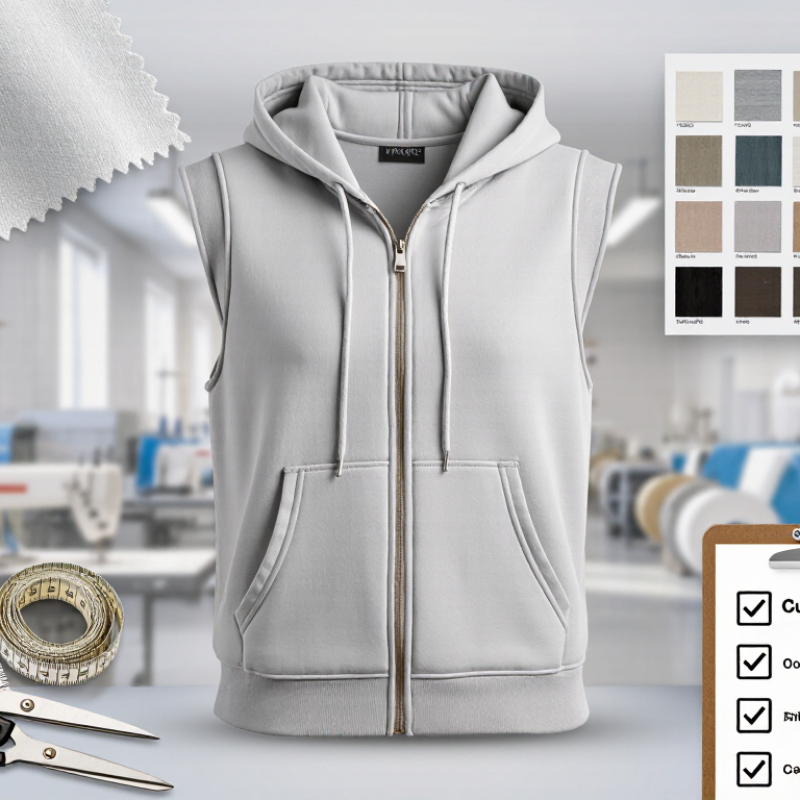
Why Choose Custom Sleeveless Zip Up Hoodie Production?

Global Demand: Activewear Market CAGR of 9.9%, Grand View Research, 2024–2030

Why Choose Custom Sleeveless Zip Up Hoodie Production?

Global demand for activewear is expanding quickly. Grand View Research projects a 9.9% CAGR for the activewear market from 2024 to 2030. This growth reflects stronger interest in training, outdoor activity, and everyday performance clothing. Custom sleeveless zip-up hoodies can answer these needs with practical details. A lightweight 240-gram fabric may suit warm gym sessions, while mesh panels can improve airflow around the back. A smooth zipper, reinforced armholes, and two secure pockets also support repeated use.

Custom production gives buyers more control over fit, materials, and seasonal design. The International Trade Centre emphasizes that product differentiation helps apparel companies compete in changing global markets. However, market forecasts are not guarantees. A 9.9% CAGR cannot predict every region, fabric shortage, or shift in consumer behavior. That matters.

Real production experience also exposes small problems. Armholes may feel tight after washing. Drawcords can become uncomfortable during movement. Sampling, wear testing, and measurement checks help identify these issues before bulk manufacturing. Suppliers should document fabric composition, color fastness, shrinkage, and quality inspections. Better records improve reliability, although they do not remove every risk. The strongest custom hoodie programs remain flexible, evidence-based, and willing to revise imperfect first samples.

The global activewear market is projected to grow at a 9.9% compound annual growth rate from 2024 to 2030, according to Grand View Research. This illustrative index sets 2024 to 100 and applies that CAGR; it shows modeled growth, not reported market revenue. A custom sleeveless zip-up hoodie can serve consumers seeking versatile, layerable activewear.

Product Definition: Sleeveless Zip-Up Hoodies, Components, Fits, and Use Cases

Why Choose Custom Sleeveless Zip Up Hoodie Production?

A sleeveless zip-up hoodie combines a hooded neckline, front zipper, arm openings, and a body shaped for layering. Common components include ribbed or bound armholes, drawcords, zipper tape, and a kangaroo pocket. Small details matter. A stiff zipper can rub against the chin; oversized armholes may expose too much of a base layer. These are easy fit problems to miss in a flat sketch.

Fit depends on intended use. A close cut works over a T-shirt for training, while a relaxed body leaves room for a long-sleeve layer. For workshop sampling, test the garment with arms raised and seated, not only standing. Check pocket depth with a phone inside. A light fleece may suit cool indoor workouts; a heavier knit adds warmth but can restrict movement. No fit works for everyone.

Material selection deserves the same care. Textile Exchange’s Materials Market Report 2024 estimates that global fiber production reached 124 million tonnes in 2023, with polyester accounting for about 57 percent. That scale makes fiber choice relevant, but a large share does not make polyester the right choice for every garment. Compare fabric weight, stretch recovery, wash behavior, and recycled-content documentation before production. Sampling can feel slow. It often catches the seam or armhole issue that bulk production makes expensive.

Customization Advantages: Fabric, GSM, Trims, Branding, and Size-Grade Control

Custom sleeveless zip-up hoodie production gives product teams tighter control over fit, comfort, and cost. Fabric selection sets the foundation. A cotton-polyester fleece can balance softness, durability, and drying speed. A 280 GSM body feels substantial without becoming overly heavy. Lighter 220 GSM fabric suits training layers and warmer markets. Textile Exchange’s Materials Market Report 2024 estimates global fiber production reached 124 million tonnes in 2023. That scale makes material decisions increasingly important, not decorative.

GSM must match the intended use. Heavy fabric needs stronger zippers, reinforced seams, and careful wash testing. Trims also affect performance. A metal zipper may look premium, while a molded zipper can reduce weight and snagging. Custom branding can include woven labels, heat-transfer marks, or tonal embroidery. Placement matters. A chest mark can distort across different sizes. Sampling exposes this risk early. The first sample may still feel wrong.

Size-grade control protects consistency across the range. A technical pattern should define chest width, shoulder opening, armhole depth, body length, and hem opening for every size. Size grading is not simply adding equal centimeters. Larger sizes often need different armhole and shoulder adjustments. Poor grading creates tight underarms or excessive side volume. The International Organization for Standardization’s ISO 8559 series provides measurement guidance for clothing size designation. Manufacturers should compare graded samples with real body measurements and movement tests. That extra check may slow approval, but it prevents costly corrections later.

Production Workflow: Tech Packs, Sampling, AQL 2.5 Inspection, and Bulk Manufacturing

Custom sleeveless zip up hoodie production starts with a clear tech pack. It should specify fabric weight, zipper length, pocket dimensions, armhole shape, seam finishes, and grading across sizes. A flat sketch alone can leave room for guesswork. Measurements and construction notes give the factory a more reliable reference.

Sampling tests whether those details work in real fabric. Check how the zipper sits when the garment is worn, whether the armholes feel restrictive, and how the hem behaves after washing. Keep notes on each revision. Small changes can shift the fit more than expected.

Before bulk manufacturing, agree on an AQL 2.5 inspection plan and define acceptable defects, such as uneven stitching or zipper snags. Inspect finished garments under consistent lighting, and record findings by size and color. No process catches everything. Clear records make problems easier to trace and help teams decide whether a batch needs correction before shipment.

Performance Verification: ISO 6330 Washing Tests, AATCC 61 Colorfastness, and CPSIA Compliance

Custom sleeveless zip-up hoodies need more than a clean fit. Their armholes, zipper tape, and ribbed hems face different stresses in wear and washing. ISO 6330 provides controlled domestic washing and drying procedures, helping manufacturers compare shrinkage, seam stability, and zipper function across samples. AATCC 61 evaluates colorfastness under accelerated laundering conditions; one test option is commonly described as approximating five home washes. It is a screening method, not a promise of years of use. Small details matter: a dark dye may transfer onto a pale lining, while a zipper can ripple after drying.

For children’s apparel, CPSIA requirements include a 100 ppm limit for lead in accessible components. Applicable testing depends on the product and materials, so request current laboratory documentation rather than relying on a supplier’s general statement. A useful production record links fabric and trim samples to test results, wash settings, and the finished garment’s measurements. This makes a failed sample easier to investigate. Still, one approved sample cannot represent every production batch; repeat checks are imperfect, but prudent.

Tips: Ask for ISO 6330 wash settings, AATCC 61 test conditions, and dated CPSIA test reports. Photograph the hoodie before and after washing, measure body length and armholes, and inspect the zipper in bright light. Keep the first results, even when they are disappointing. A slightly uneven hem is a clue, not just a cosmetic annoyance.

FAQS

What is a sleeveless zip-up hoodie?

It has a hood, front zipper, open armholes, and a body made for layering. Many versions include a kangaroo pocket and drawcords.

How should the fit be chosen?

A closer cut can work over a T-shirt for training. A relaxed fit leaves room for a long-sleeve layer. No fit suits everyone.

What should be checked during a fitting?

Raise your arms and sit down while wearing the sample. Check whether the armholes pull and whether the zipper rubs your chin. Small details matter.

How can pocket size be tested?

Place a phone inside and move around. Check that the pocket feels deep enough and does not shift awkwardly.

What fabric details matter before production?

Compare fabric weight, stretch recovery, and wash behavior. Review recycled-content documentation where relevant. Polyester is widely used, but that alone does not make it the right choice.

What should a tech pack include?

Specify fabric weight, zipper length, pocket dimensions, armhole shape, seam finishes, and size grading. A flat sketch may leave too much open to guesswork.

Why make a sample before bulk production?

A sample shows how the zipper, armholes, and hem behave in real fabric. Wash it and record each revision. Sampling takes time, but missed fit issues can cost more.

What does an AQL 2.5 inspection plan help check?

It sets an agreed approach for reviewing defects, such as uneven stitching or zipper snags. Inspect garments under consistent lighting and record results by size and color. It will not catch everything.

Conclusion

Sleeveless Zip Up Hoodie Production offers apparel businesses a flexible way to meet growing demand for versatile activewear. With the activewear market projected to grow at a 9.9% CAGR from 2024 to 2030, according to Grand View Research, this garment can serve a range of needs, from training and layering to casual wear. Its design typically combines a hood, front zipper, arm openings, pockets, and adjustable details, with fit options suited to different activities and customer preferences.

A well-managed production process turns design requirements into consistent finished garments. Teams can select fabrics and GSM, specify trims and branding, and control sizing through detailed grading. The workflow usually covers tech-pack review, sample development, bulk manufacturing, and AQL 2.5 inspection. Performance checks, including ISO 6330 washing tests, AATCC 61 colorfastness testing, and CPSIA compliance review where applicable, help assess durability, color retention, and product suitability before delivery.

Clara

Clara

Clara is a highly experienced marketing professional dedicated to helping businesses understand how thoughtful products, reliable service, and customer-focused solutions can create lasting value. With a strong understanding of the company’s offerings, she translates complex product features into......